


Poetry Expo 26
/ 2 February 2026
Philopoemen, Proteus, Cyborg and Me On the Planet of Poetry
Poetry Expo 2026
Walter Benjamin quotes the following sentence in his essay The Work of Art in the Age of Mechanical Reproduction: “In 1927 Abel Gance exclaimed enthusiastically: “Shakespeare, Rembrandt, Beethoven will make films . . . all legends, all mythologies and all myths, all founders of religion, and the very religions . . . await their exposed resurrection, and the heroes crowd each other at the gate.”(Benjamin, 1969, p.4).
This inspiring prediction is also valid in the context of image and text generation with artificial intelligence.
In addition, cyber culture and AI creativity are protean performance environments.
Moreover, in the promptographical context, the works of Classical Age writers such as Hesiod, Homer, Ovid, and Pausanias are artistically and methodologically inspiring sources.
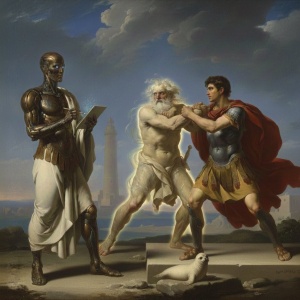
When we generate poetry and imagery in a co-existence environment with Artificial Intelligence, I aim to represent Classical Mythology with a postmodern logic of anachronism, and each text is accompanied by relevant images.
The project is part of the subtheme Writing After – Catastrophe, Memory, and the Archive of Loss.




Author
Simber Atay
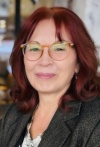
Dr. Simber Atay was born in Gaziantep, Turkey, and studied Cinema and Television at the Faculty of Fine Arts at Ege University. Her academic and research trajectory has long engaged with film, photography, and visual culture. Her early research includes Kemal Sunal’s Comedy (1980), followed by The Early Period of Photography and Ottoman Photographers (1983), and her doctoral dissertation Approach Forms in Turkish Film Criticism (1990), which shaped her later critical approach to cinema and media.
She taught and conducted research at several academic institutions, including Dokuz Eylül University, across the Faculty of Fine Arts, Institute of Fine Arts, Faculty of Education, and Institute of Educational Sciences, as well as at Anadolu University’s Faculty of Communication Sciences. Throughout her academic career, she has explored photography theory, postmodern art, cyberculture, and the philosophy of distance education, later expanding her research towards artificial intelligence and creative performance.
She currently works as an independent researcher, continuing to examine the evolving relationships between visual culture, technology, and contemporary artistic practices.


