


Author of the Week
/ 23 October 2026
Fragments of a Cuir Cartography
Author of the Week: Mexico
Versopolis Academia
Abstract: This essay integrates spatial analysis, critical theory and autoethnographic narrative to examine how cuir[1] bodies navigate, resist and transform normative urban environments. Rather than treating the closet as a private metaphor, it reads it as a tangible architecture of regulation – an epistemological infrastructure that dictates mobility, visibility and spatial belonging. Moving through liminal urban thresholds, nocturnal enclaves and affective archives of shame, desire and trauma, the text interrogates how built environments discipline non-normative bodies and where desire negotiates unpoliced expression. Grounded in a decolonial Latin American perspective and articulated through a hybrid method of theory-fiction, the essay contends that cuir cartography is not a static territorial delineation, but an embodied, fragmented practice of survival, evasion and spatial reclamation.
Keywords: Queer Space, Queer Phenomenology, Theory-Fiction, Spatial Politics, Queer Embodiment
Prelude
This text is a dérive – a drift through memory, longing and city space, woven from fragments and the fleeting textures of embodied experience. What unfolds is not a universal manifesto, but a situated and affective method of knowing. The narrative and poetic passages that follow do not stand outside theory; they are its raw material, functioning as lived evidence alongside abstract frameworks.
Fragment I: Thresholds — What Is Not Named, Still Exists
‘...there is no queer space, there are only spaces put to queer uses.’
– George Chauncey, Stud, Architectures of Masculinity (1996)
What is not named still exists. What is named becomes immediately contested. The cuir body begins as a territory irreducible to imposed formulas, learning to occupy space through calculated presence and unsettling the boundaries of civic belonging. Cuir is not a fixed identity but a way of inhabiting detours, moving through in-betweens and disobeying mapped-out paths.
What is not named still exists.
And yet, what exists does not always have the right to be spoken.
Cuir is not a fixed identity but a way of being in the world. It is inhabiting the detours, moving through the in-betweens, disobeying mapped-out paths. It is both an escape and a fracture. It is learning to navigate a city that encodes which bodies can exist without question and which require a perpetual amendment.
Nevertheless, I recognise the societal need for language. Words make us manageable, turn us into something legible. For the sake of convenience – because the world still wants to fit desire into binary categories – I sometimes say I am bisexual. Not because the word suffices, but because it saves me the fatigue of explanation, the need to justify my desire to strangers. If I am honest, bisexuality is not enough either. My desire is a glitch in the machine of language. It does not fit into predefined codes. There are other, more expansive words, but to name them is to give an unsolicited lecture on sexuality every time someone asks whom I sleep with. I prefer to spare myself the effort.
Consequently, my identity is shaped by social expectations, formed less by personal choice than by necessity. My movement to the margins is not voluntary, but rather a consequence of societal reluctance or refusal to engage with complex truths. I do not resent this reality, but I recognise it. In a world where existence itself is often a negotiation, inhabiting oneself becomes an act of constant balance – between authenticity and survival, between who I am and who others insist I should be.
But there is a moment – a fraction of a second before someone asks, before I must offer a digestible answer – when I exist without a name, without translation.
A second in which the body is simply body, where desire does not need to be tamed, where the history imposed upon me does not yet reach to ensnare me.
That interstice, that sliver of freedom lasting only a blink, is the only space that truly belongs to me.
Fragment II: Territories – The Body as Contested Ground
Before desire was named, the body was already under surveillance. They called me maricón before I knew what the word meant – before I understood that I inhabited a body perceived as an anomaly. The term maricón – (adj. & n.): originally an augmentative of marica, now most often used to describe a homosexual man or one perceived as effeminate – arrives before any self-knowledge, before love, before touch. A slur that precedes the formation of desire, shaping it retroactively through shame.
A word no child should hear before falling in love for the first time.
They said it in the way they looked at my mother, suspicion hanging in the air, as if my existence had already been foretold. In the uneasy glances when I played with dolls instead of toy cars. In the urgency with which they corrected my voice, my posture, the way I looked at other boys. In the nervous tone of someone who, without realising it, revealed the future I had yet to understand. And in the unspoken warning that a body is never just flesh and bone, but also expectation, burden and duty.
In response, the body trained itself: back kept upright, voice kept level, laughter quieted. Shame embedded itself through whispers, averted glances and the disciplinary silence of adults. The body became the first geography of fear – contorted and compressed to avoid notice.
From early childhood, the cuir body is mapped by external forces. As Michel Foucault asserts, the body is not a passive container but a surface where power is enacted and contested. If traditional urban planning imagines mobility as the rational optimisation of flows, cuir mobility operates through an entirely different logic: an affective choreography grounded in risk, exposure and strategic withdrawal. Urban infrastructure is historically designed around normative bodies – the nuclear family, the productive citizen, the heteronormative gaze. Within this order, cuir desire remains peripheral. To inhabit a cuir body is to navigate the politics of visibility: seeking presence without justification and moving through space with tactical intent.
Fragment III: Labyrinths – The Closet as Spatial Infrastructure
The closet is not merely a metaphor; it is an architecture of regulation. It operates through layered mechanisms of surveillance, spatial codes of the permitted and the clandestine, and unspoken norms structuring visibility.
This architecture manifests early in gendered spaces such as locker rooms and communal showers – initial borders where the body becomes spectacle and threat simultaneously according to normative masculinity. Within them, the cuir subject learns to modulate gesture, deflect eye contact and read the built environment as a map of potential exposure. This surveillance does not dissolve with adulthood; it simply mutates. In saunas, streets and semi-public spaces, regulation persists through heteronormative codes. Desire is forced into an ethics of discretion where even a lingering glance can trigger discipline.
As Eve Kosofsky Sedgwick theorises, the epistemology of the closet is not a static binary of inside and outside, but a grid of knowledge and power that governs who may speak and under what terms one is rendered legible. It operates discursively and spatially – not through confinement but through internalised regulation. It is less a door than a corridor – a sequence of rooms in which identity must constantly be recalibrated according to shifting social codes. To inhabit a cuir body, then, is to dwell in a condition of spatial precarity. The city becomes a map of conditional permissions – a fragmented terrain marked by zones of risk, negotiation and momentary reprieve.
Before I learned to love my body, I learned to flee with it.
Fragment IV: Folds – Clandestine Geographies
‘Queer spaces are, by definition, sites of tension – simultaneously ephemeral and resilient, both hidden and hyper-visible. They exist in the interstices of the urban fabric, as forms of resistance against the normative ordering of space.’
– Jack Halberstam, In a Queer Time and Place
We are told the city belongs to all of us, that its public spaces are inherently democratic. But for cuir subjects, hospitality is conditional. In his theorisation of non-places, Marc Augé defines transit spaces – highways, airports, lobbies – as sites of circulation rather than belonging. For cuir bodies, the broader city often functions as a non-place where existence is shaped less by arrival than by evasion. Desire is relegated to fleeting occupancies: nocturnal parks, restroom stalls, the margins of streets.
Yet these non-places accumulate memory. They form a clandestine cartography – a lived geography of longing mapped through absence. Drawing on Sara Ahmed’s queer phenomenology, space is never neutral; it is loaded with expectations of how bodies should orient themselves. Hence, desire in these spaces is not aimless – it is tactical. The cuir subject navigates the city with a spatial intelligence shaped by precarity. Movement becomes a method of deciphering unspoken norms: where one may linger, where desire might unfold, where silence offers safety and where it renders one vulnerable. The act of walking becomes a practice of spatial literacy – an embodied reading of power, danger and possibility.
By day, the city performs inclusion through open parks and pedestrian promenades. By night, normativity retracts, revealing another terrain where cuir desire negotiates improvised sanctuaries in the half-light of risk. The non-place is thus reimagined: an urban crack where bodies not meant to belong insist on existing.
Fragment V: Descent – The Rhythms of Risk
‘Queer desire has always had to invent its own spaces, its own maps of possibility. Whether in parks, bars, or digital landscapes, these encounters are never just about pleasure – they are also about survival, about the negotiation of visibility and risk.’
– Samuel Delany, Times Square Red, Times Square Blue
Within the urban syntax, cuir bars and clubs function as spatial exceptions – liminal enclaves that temporarily suspend normative surveillance. These sites are not stable institutions; rather, they operate as parenthetical spaces within the dominant urban syntax. Like public restrooms or nocturnal parks, they are spatial interruptions – counter-architectures in a city that otherwise allocates space according to heterosexual, reproductive and capitalist logics. Their subcultural durability is not guaranteed by legal recognition but by repetition, memory and risk. They are at once real and metaphorical, existing both in bodies and in place, both in rupture and repetition.
In Budapest’s Jewish quarter, passing through an unmarked door into a crowded basement club revealed an immediate atmospheric shift: humidity, bass and bodies moving in counter-temporality. For a moment, the discipline governing everyday gestures receded, replaced by a visibility where the self became a site of desire rather than regulation.
Yet these spaces do not dismantle the closet; they reconfigure it. Inside the club, the social contract shifts from repression to intensified performance. Judith Butler’s framework of performativity operates acutely here: new taxonomies of embodiment: bears, otters, jocks, twinks. Chacales, chichifos, papis. Femmes, masc, trans, vestidas, dragas. Top, bottom, dom, sub, pup. Each has its own semiotics, exclusions and hierarchies. These are not merely playful labels but cultural technologies that organise desire at the intersections of race, class, gender identity and body aesthetics. Liberation coexists with stratification.
In a basement venue in Berlin, surrounded by mirrors and red leather, power circulated through aesthetic codes and cultural scripts I had not been taught to read. My racialised body was made legible, yet filtered through an economy of exoticism. Alcohol operated not as an instrument of liberation, but as a compensatory mechanism to numb the awareness of exclusion and suspend the burden of illegibility. At the periphery of the darkroom, the closet revealed its capacity for migration: carried forward in hesitation, tone and the persistent question of whose gaze validates the performance of identity. And that, perhaps, is the most insidious trait of the closet’s architecture: its capacity for migration. We do not leave it behind so much as we carry it forward – embedded in gesture, in tone, in the minor hesitations that shape our daily negotiations of desire and safety.
Fragment VI: Desire as Drift – Memory and Performance Cartographies
‘Memory is not an object that one possesses; it is an active, living force that shapes the body, the self, and the way we navigate the world. The past does not stay in the past – it inhabits us, written into our flesh.’
– Ann Cvetkovich, An Archive of Feelings: Trauma, Sexuality, and Lesbian Public Cultures
Desire for cuir subjects is rarely unburdened; it is historicised and regulated. As bell hooks reminds us, desire is never experienced outside structural inequality. The body functions, in Cvetkovich’s terms, as an archive of affective residues – storing trauma, pleasure and the memory of violence disguised as neglect.
Sex, for me, was not revelation – it was malpractice, or ambush. It unfolded on a night that began with freedom: dancing, intoxication, the feeling of being wanted. I surrendered to the moment without measuring my movements, for once unburdened by the gaze.
A handsome man, fashionably late, always in time for a fever dream. He found me on the dance floor to a choreography of reckless abandon, darkness a willing accomplice. The righteous bodies parted like silk curtains. Lights cast shadows across his face. Beautiful, or so they say. Wanting to believe I’d chosen him. But if I hadn’t – had he chosen me?
I followed, hungrily. The hunger of a man, or a beast. Man or beast? A beast, perhaps – fighting custody of a man who never found peace. And what is fasting without the temptation of a feast?
Up a spiral of crooked steps – a metaphor I failed to read. Desire, feral and chemical, moving ahead of time and space.
His muscles knew the hunting tactics, graceful, unrehearsed. I had seen this scene from afar, many times from the other side, yet let myself be led, tethered to the musk at his neck – poison or ecstasy, I could not tell. Even then, at the edge, I managed a whisper: No.
But no was not enough. A pause. A breath. An almost.
Delirium. Betrayed with a kiss. Easy to dismiss a dying, hungry beast.
So he killed me anyway. Not with enough violence to break me, but slowly – on the cross of his bed, where I posed no resistance. Why now? I had spent a lifetime resisting. What was one more death, dressed in velvet and bliss?
And I came back. Despite the tears, the aftertaste of blood released. Not after the third day, but perhaps the third year.
No sacred heart was pierced in my name. No crows spared my eyes – a feast. No Madonna washed my feet.
No one wept for innocence, because men, they say, must save themselves.
The father did not forgive. The son never looked my way. The spirit felt everything but holy.
There is no canon without shame. Can a dead martyr feel guilt?
Interlude – Dissonance: Ambivalence, Affect and the Limits of Legibility
The body is a mutable archive where history, doctrine and instinct collide. As Eve Kosofsky Sedgwick demonstrates in Epistemology of the Closet, the closet operates not as a threshold crossed once and for all, but as an enduring regime of knowledge – a spatial grammar of the visible and the veiled that dictates how desire may be known, permitted or disciplined. Even when physically outside its architecture, the subject remains governed by its interiorised logic: the habit of caution, the debt of guilt and the tacit conviction that pleasure must always be negotiated through shame.
The profound rupture of violation lies in its dissonance: the irreconcilable friction between bodily sensation and what the body carries. In that room, stillness was not consent, but a learned technology of self-preservation – the somatic inheritance of knowing that resistance can provoke greater catastrophe than silence. Sleeping on the floor afterward was an immediate spatial reorientation: a retreat from touch when skin could no longer bear the weight of containment.
In the aftermath of an experience shaped by ambivalence and embodied vulnerability, it becomes exceedingly difficult to disentangle desire from harm. When desire precedes, coexists with, or even survives the moment of violation, the subject is left without a stable grammar through which to interpret what occurred. If part of me wanted what happened – if I returned, if I desired – I am forced to confront the limits of conventional categories like abuse, consent and misconduct. The critical question is not merely whether a boundary was voiced, but how one’s capacity to refuse is structurally eroded by centuries of heteropatriarchal discipline, the social myth that men are inexhaustibly willing subjects, and the internalised mandate that cuir desire is inherently suspect. In this matrix, mourning becomes fraught: grief is inextricably entangled with the persistent, disquieting pulse of longing.
To inhabit a cuir body is to live within this contradiction – holding historical suppression in the muscle memory and learned paralysis in the bones. Returning to the space of transgression is not a failure of discernment; it is the harrowing consequence of an affective economy where recognition and validation are so scarce that they are purchased at the expense of self-preservation. When he disregarded my refusal, it was not an isolated body in that room. Present also was the accumulated silence of an entire lineage of bodies that learned to stay quiet – encounters suspended in irreducible ambiguity, exceeding every tidy category of violence, intimacy and desire.
Fragment VII: Desire as Drift – Skin as Archive, Shame as Syntax
‘Desire is not simple. It is saturated – with memory, with punishment, with longing, with fear.’
– Ann Cvetkovich, An Archive of Feelings
I wake with deliberate resistance,
inhaling not out of need, but protest.
Not metaphor, but practice.
My body has always breathed incompletely,
haltingly, half-lit.
Air never arrived without condition–
and still, I breathe.
That morning, it is not the residue of sex that unsettles me,
but guilt.
Not emotion, but atmosphere:
a spatial imprint clinging to skin
long after the sheets are cold.
The room feels like aftermath.
I move with reverence for the shame
that stirs when I dare to feel free.
The choreography is known to me:
the stretch met with silence,
a body unpracticed in receiving pleasure without debt,
still unsure whether desire is something to claim–
or atone for.
Shame does not follow pleasure; it shadows it.
A cost arriving with the very breath of want.
Shame is not opposite of desire–
it is its syntax.
In this dissonance, the flesh is an archive
not just of touch, but of the terms that made touch possible.
It remembers being seen before knowing how to look back;
it remembers yielding because freedom
had never been modelled without guilt.
Desire is not clean–
it is sticky, structured by fantasy,
shaped by injury.
I return to the same rooms,
the same urgent desire that vanishes
like a guest who never cared to learn my name.
Some mornings I return to a name I should have forgotten,
to the memory my skin refuses to surrender.
Because the body remembers.
Even when you beg it to forget.
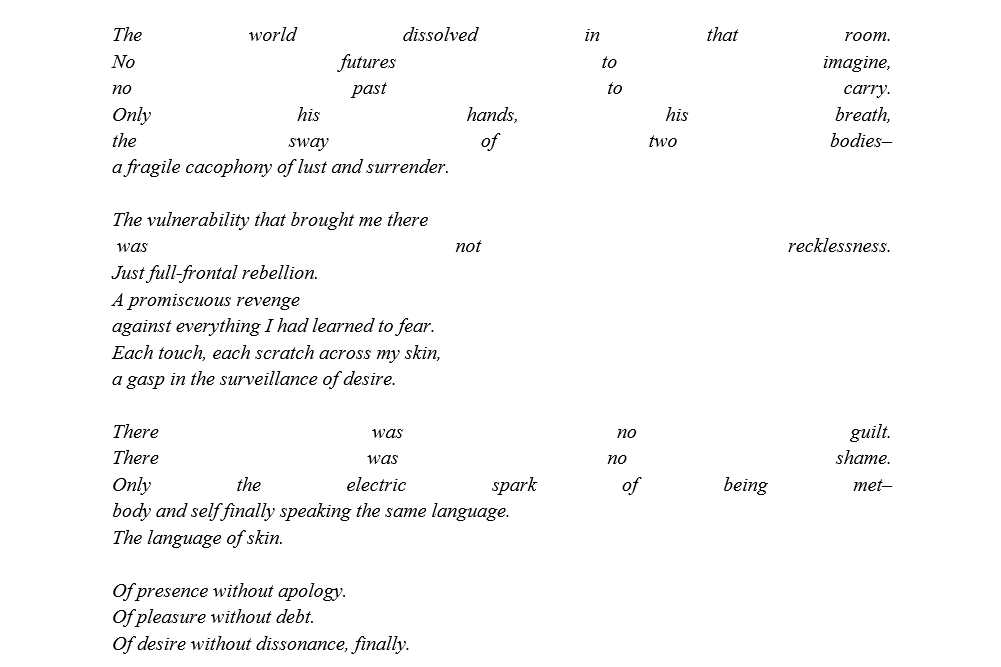
Fragment VIII: Freedom – The language of my skin
End note: Cartographies of Resistance
An ephemeral encounter is no less real. Intimacy – particularly the kind that unfolds without witnesses – is where history and sensation collide. It is never outside politics; it is the site where desire and surveillance cohabit, where the cuir body stores both harm and hope. Scars, visible or concealed, become coordinates of having desired and survived.
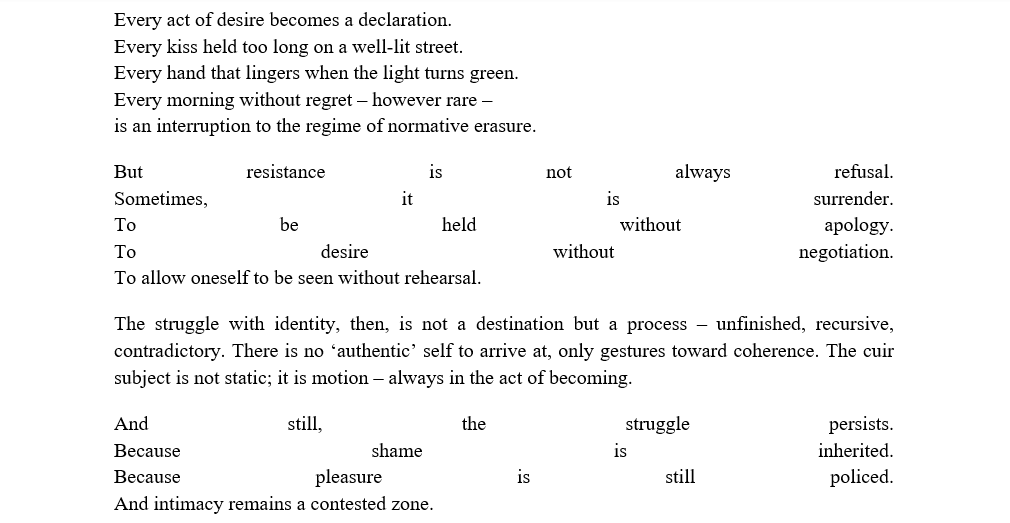
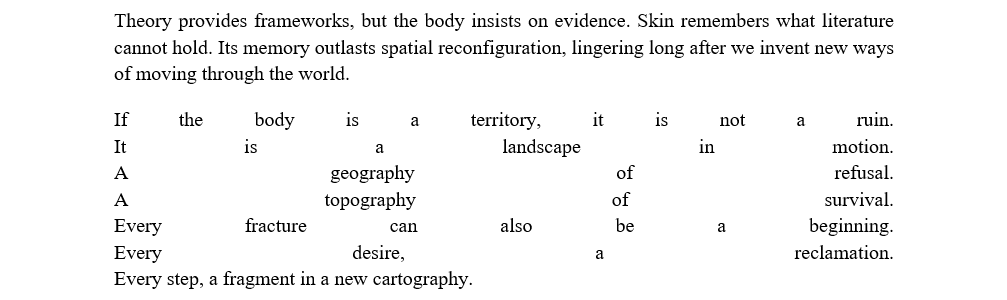
The regulatory force of the closet governs not only what is seen, but what is permitted to be felt without punishment. In this matrix, the body operates as both document and front line:
References
Ahmed, S. (2006). Queer phenomenology: Orientations, objects, others. Duke University Press. https://doi.org/10.1215/9780822388074
Berlant, L. (2011). Cruel optimism. Duke University Press. https://doi.org/10.1215/9780822394716
Butler, J. (1990). Gender trouble: Feminism and the subversion of identity. Routledge. https://doi.org/10.4324/9780203824979
Cvetkovich, A. (2003). An archive of feelings: Trauma, sexuality, and lesbian public cultures. Duke University Press. https://doi.org/10.1215/9780822384434
Delany, S. R. (1999). Times Square Red, Times Square Blue. New York University Press. https://doi.org/10.2307/j.ctt9qfd55
Foucault, M. (1978). The history of sexuality: Volume 1: An introduction (R. Hurley, Trans.). Pantheon Books.
Halberstam, J. (2005). In a queer time and place: Transgender bodies, subcultural lives. New York University Press.
hooks, b. (2000). All about love: New visions. William Morrow.
Sedgwick, E. K. (1990). Epistemology of the closet. University of California Press.
[1] Note on Terminology: Why Cuir instead of Queer? – The choice to use cuir rather than queer is intentional. Cuir is a decolonial reworking emerging from Latin American contexts to challenge the hegemony of Anglo-centric frameworks in gender and sexuality. This linguistic shift foregrounds the specificities of identities shaped by colonial histories, racialisation and local resistance. I write from within this fracture – northern, Mexican, cuir – navigating urban territories from Buenos Aires to New Delhi where space orchestrates how bodies move, how desire is structured and how shame is inherited.





Author
Luigi Barraza Cárdenas

Luigi Barraza Cárdenas is a Mexican architect, urban designer and writer whose practice operates at the friction points between spatial analytics, critical theory and the poetics of everyday life. An attentive observer of place, he uses kinetic methods – walking, lingering and mapping – to investigate how urban landscapes hold memory, institutional tension and bodily transformation.
He holds an MSc in Sustainable Urbanism from The Bartlett School of Planning (University College London) and Transport Certificates from the University of Oxford. His research engages the intersections of territorial governance, decolonial urbanism and cuir spatial phenomenology, examining how marginalised bodies navigate architectures of surveillance and regulation. Alongside his professional practice leading multidisciplinary planning and civic design frameworks internationally, his hybrid writing and research explore postcolonial spatial dynamics, theory-fiction and emerging literary cartographies across Latin America and Europe.


