


Author of the Week
/ 25 May 2026
‘What, then, is poetry?’
Author of the Week: North Macedonia
The poetics of the in-between: Novecento and Antoine on the threshold of non-belonging
When I am asked what poetry is, I feel as if I enter the same circle St Augustine entered when he reflected on time: ‘What then is time? If no one asks me, I know; if I wish to explain it to him who asks, I do not know.’ I do not take this as a paradox, but as a precise articulation of an experience that resists reduction.
I too ‘know’ what poetry is as long as I am within it – as long as the word opens more than it signifies, as long as an image creates a space which I enter without resistance. But the moment I have to explain it, I realise that this knowledge cannot be held. It dissolves precisely in the attempt to make it stable.
Poetry is close to time not only as a metaphor, but as a structure. Both time and poetry are understood only while we are within them – I cannot observe time from the outside, I can only live it. Likewise, I cannot see poetry as something entirely separate from myself – I can only participate in it. The moment I try to fix it, turn it into a stable object of knowledge, it begins to crumble.
‘Most of my life I have devoted to literature, and all I can offer are doubts’, says Borges, and somehow, I see myself in those words as well. Therefore, everything that follows about poetry, even if closed with a full stop, carries within it the quiet hesitation of a question mark.
Poetry, then, is not something I possess as knowledge, but something that possesses me as experience. It is not an object of analysis, but a medium in which transformation occurs. It does not teach me what to think, it puts me in a state in which thinking is no longer sufficient.
At the boundary between affect and logos, words cease to be tools and become events. Each verse is an occurrence of meaning, not its fixation.
Poetry almost never appears where I expect it. It does not come when I try to understand it, or when I attempt to discipline it into clear thought. It seeps in through the cracks – in moments of inattention, in the pauses between two sentences, in that brief hesitation when the world seems uncertain as to whether to continue or not. And precisely then, quietly, something opens.
Not as an idea I can formulate, but as a process I am already part of before I become aware of it.
Poetry does not begin on the page, it begins much earlier – in the restlessness that smoulders within the one who writes. Although the poet sometimes believes they do not know what they are doing, there is always a deep, intuitive knowledge of the process, even when the meaning of what is created cannot be explained.
In the act of writing itself, the poet must believe they are creating something of utmost importance for the world, but once the work is finished, they must push it away as something of least importance, in order to remain open to new creation.
Although words wear out over time, their true freshness is revealed in the way they connect with one another. Every poem has its own colour, and the poet must expand their spectrum while saving some space for emptiness. And emptiness often demands a descent into memory, but once the poem is written, it must be released – even forgotten – to make room for another.
Poetry often hides, playing hide-and-seek with its creator, quietly maturing within them. It does not tolerate patterns or predictability; rather, it demands that even the most distant things be brought into relation, that unexpected encounters be created.
Therefore, when I read poetry, I do not try to ‘understand’ it in the traditional sense. I try instead to remain open enough for something to happen within me. That something is rarely dramatic, and most often it is an almost imperceptible shift. But it is precisely in those small shifts that its depth lies. In such moments, I feel a particular form of certainty a sense of belonging to something that does not require me to be enclosed within a definition.
In poetry I can exist as a process, as a movement that does not need to culminate in a conclusion. It allows me to remain unfinished without that implying a lack. In the end, writing poetry is an endless immersion into the ocean of language, a space without beginning and end, where each poem is a new discovery. But the effort to say everything may ultimately lead to silence. Meaning, therefore, exists only within measure.
In this context I often return to Alessandro Baricco’s novel Novecento, which tells the story of a man who spends his entire life on a ship. Novecento is found as an abandoned baby aboard a vessel where sailors raise him and name him after the new century. For him, the ship is not merely a place where he lives, but an entire world – closed, yet infinite in its internal dynamics, with its own rules, people, stories and a constant movement between Europe and America.
As he grows up, Novecento reveals extraordinary musical talent and starts playing on the ship’s piano. Without formal education, he develops a unique style, inspired by the passengers he encounters daily and by the sounds of the ocean itself. His music becomes legendary, each performance seems to recount the destinies of the people travelling on the ship, their desires, loves and losses. In this way, he becomes a silent witness to countless human lives passing through his limited yet rich world.
Although the ship is his entire universe, Novecento develops a profound imagination of the outside world he has never seen. The land exists as an infinite, almost frightening idea, a world without boundaries, without beginning or end, in which one might lose oneself. This image gradually grows within him and becomes the source of his inner dilemma: whether to remain in the security of the known or to confront the unknown.
The decisive moment of his life comes when he is finally given the opportunity to step onto land and leave the ship. It is a moment of choice that carries the full weight of his life story. Although curiosity exists, he cannot bring himself to cross the boundary of what he knows. For him, the world beyond is not only freedom, but an overwhelming complexity that cannot be ‘played’ or understood like a musical composition.
I do not interpret his choice as fear of the world, but as an awareness of the measure within which he can exist. The ship, limited and defined, allows him to create an infinity that can be lived. The land, with its boundlessness, would shatter that possibility.
In poetry, I recognise that same ship. It gives me boundaries within which meaning can appear without dissolving into its own labyrinths. And perhaps that is why I no longer try to define it. It is enough to recognise it when it appears – in brief openings of the world, in sentences that refuse to close. There, on the edge between understanding and its absence, poetry continues to happen. In such moments, I feel a form of certainty that does not arise from stability, but from belonging to something that does not require me to be finished. In poetry I can exist as a process, as a movement that does not need to be completed. It allows me to remain undefined without feeling lost.
Therefore, I do not understand Novecento’s decision to continue his life on the ship as a rejection of the world, but as the choice of an ontological position. The ship is limited, yet it is precisely in that limitation that the possibility of a liveable infinity emerges. The land, with its immeasurability, does not offer more freedom, but another form of loss, a loss through excess.
For me, poetry is that ship. A space that does not enclose me, but keeps me within a measure in which I can exist without scattering. Outside lies the infinite, ungraspable ocean of meanings, yet it is precisely through poetry that I can establish a relation with it, without being swallowed by it. Behind it is the space of measure (the ship) where infinity can be shaped into notes, where the world can be formed into rhythm. Ahead of it is the land, an openness without boundaries where possibilities are not limited, but are also untouchable, for that very reason.
The poetic space is also a space of loss. Just as Novecento does not step onto land because ‘everything is possible’ there, so too does the poet often face the blank page as an infinite territory that must be limited in order to become meaningful. The paradox is that only when you limit yourself do you truly begin to create. The boundary is not the opposite of freedom, but its medium.
Here we see an important poetic truth: form is not a limitation of freedom, but its condition. The sonnet, the haiku or free verse are not merely technical choices, but ways in which infinity is scaled down to human measure. Without this, language would collapse into chaos, just as Novecento would be lost on land without structure.
And it is precisely for this reason that poetry often appears as an act of control, but in essence it is an act of trust: trust that from a small number of words, a world can be created. Just as Novecento’s music exists only within the limits of a keyboard with a finite number of keys, yet still remains in contact with infinity, so too does the poem live within a limitation that is constantly exceeded from within.
In this sense, the poetic space is not a place where something is lacking, but a place where there is nothing in excess. Every silence is a part of meaning, every pause a part of rhythm. And it is in that carefully constructed emptiness that ‘meaning’ appears.
The poetic space is not a closed world, but a carefully chosen illusion of closure in which infinity can finally become legible. The poet does not live in a world of choice, but in a world of the delayed step. They know that every word opens a thousand others that remain unspoken. And it is precisely those unspoken words that hold the poem upright, like invisible pillars. Thus poetry becomes an architecture of absence: what is missing does not weaken it, but sustains it.
Borges’s library and Novecento’s ship are closely related structures: both are ‘closed systems’ that contain infinity. In Borges, infinity is intellectual and textual, while in Novecento it is sonic and emotional – in poetry, these two worlds merge: the sound of the word and its semantic boundlessness. And in that unresolved ‘in-between’ in which Novecento finds himself something essential emerges: (non-)belonging as a condition of existence. Novecento does not fully belong either to the ship or to land; his position is precisely that threshold, that passage which cannot be crossed without losing something essential.
Poetry exists at that boundary. It is neither entirely inside nor entirely outside the world. It exists as a threshold, a place I can occupy without being forced to choose a final position. I can stay in that in-between space without feeling that anything must be closed.
On the other hand, when I am outside that space, when I disembark onto land of clarity and definition, I am reminded of the ending of the movie The 400 Blows. This cult film by François Truffaut follows the story of Antoine Doinel, a child growing up in a neglectful family environment, constantly clashing with school and authority. Misunderstood and punished, he commits small transgressions, which eventually lead to him being sent to a correctional institution. He manages to escape, and in the final scene he runs across fields, past houses and rows of trees, across the sand, all the way to the line where the waves begin, the rim of the infinity of the sea which he cannot cross, but can only stand before. Like someone who has reached the shore but does not know whether it is an end or a beginning. This scene can be read as an inverse image of Novecento – not standing at the threshold, but running towards it without any clear possibility of stopping.
Antoine does not reflect like Novecento – he does not hesitate, he runs. His escape is not a plan but an instinct, a movement that seeks to surpass every form that has enclosed him. Running through fields, past houses and rows of trees is a gradual shedding of all the layers that have defined him, each step a rejection of a world. But when he reaches the sea, for the first time he collides with something that cannot be surpassed – a boundary that appears as infinity itself. The running brings him to the end of the world he knows, but not into a new world. Instead, it brings him to something that cannot be named. If Novecento is pushed away from infinity and therefore does not step off the ship, Antoine arrives at infinity and does not know what to do with it.
The sea is like a blank page. Antoine stands before it as before a language he does not yet know. His face, frozen in the final frame, is not an answer, but a question. It is the face of someone who, for the first time, feels the weight of freedom. And here the scene closes with its strongest image: not as the end of escape, but as the beginning of something that cannot yet be seen.
If Novecento chooses a limited world in order to create infinity within it, Antoine abandons all limitation and confronts an infinity he does not yet know how to turn into life. Therefore, his running does not end in a destination, but in a question that remains open – like a horizon that can never be reached, even when standing directly before it. When he finally reaches the sea, he does not receive an answer, but a boundary that opens like a horizon.
Poetry, for me, is somewhere on that boundary. Not as a line that divides, but as a space that allows being in-between. Not out of fear, but out of awareness that something is preserved there which would otherwise be lost in motion. It does not offer stability but orientation. It does not tell me where I am, but shows me that I am in movement.
Like time, I cannot hold it; like experience, I cannot replace it. It reveals itself while I am within it, and disappears when I try to hold it. And perhaps that is where poetry most fully exists: not in the words I write, nor in the meanings I extract, but on that threshold full of possibility, where the world is neither fully conquered nor fully abandoned. I stand there, in a space that leads nowhere except towards the very act of being.
Behind me is the known; before me, the immeasurable. And poetry is neither one nor the other. It is the threshold itself. The place where I do not fully belong – and therefore I finally am.


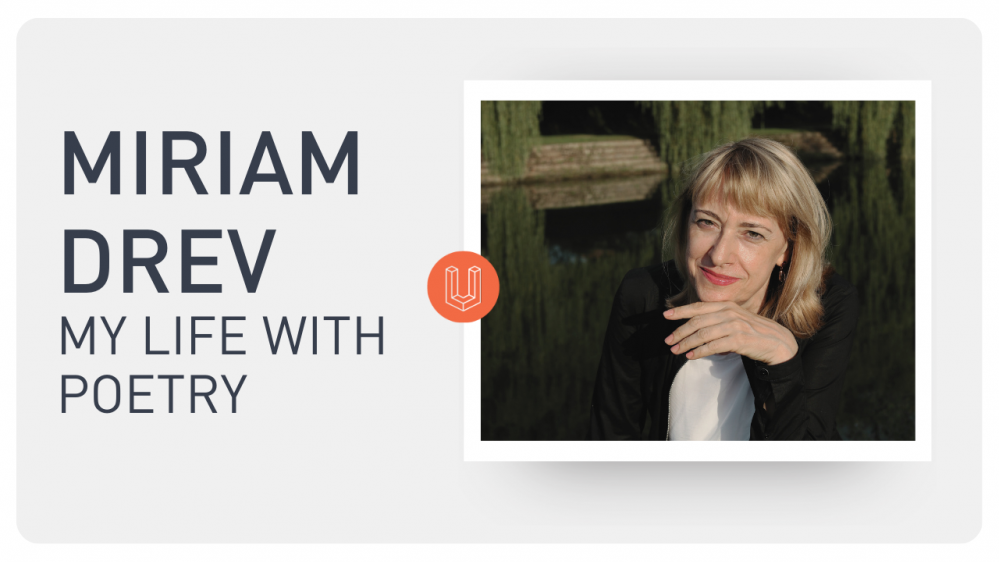


Author
Nikolina Andova Shopova

Nikolina Andova Shopova (1978) was born in Skopje. She graduated from the Faculty of Philology (Macedonian and South Slavic literature) at the St Cyril and Methodius University in Skopje. She writes poetry and her haiku takes part in the anthology of the new wave of Macedonian haiku. She has published two books of poetry The entrance is on the other side (2013) and Connect the dots (2014).


