


Author of the Week
/ 18 March 2026
Polyethylene and the flower
Author of the Week: Spain – Madrid
On nature and artifice
authorship of the end of the world
i
collective guilt is engineered impediment
in the face of unrelenting nature
unbridled winds the turmoil of the storm
the ejected fury of the volcano
the tectonic kiss
erect there stands the individual upon the earth
tiny arms made to mould bifacial tools
a brain filled with mes artificial and believer
harvesting apples for the fall
invented and notarized orphan of gods
ever un-paradised
and teeming with archangel-blowflies
that hover over the multihuman wound
imagine an end of the world
that will forgive the inexcusable
ii
but before collective wretchedness
macrolives universecrashes holocausts or exterminations
there is also the hecatomb for one
for the scale of the end of the world is as cosmic
as it is micrometric
meagre lilliputian misfortunes mute to anyone’s ears
that are aerolites upon the peaceful
sorry bathtub tsunamis with a lone body fumbling for the vein
sordid is the door that guards the neighbour’s home
full of bitten nails and due dates
poor poultry
buried swollen and obscene
the pain of one is armageddonic hyperdesolation too
tiny inner aches stretch into the hangnail
solar systems with their cosmic supernova star
that bursts in the spring of the allergic
dinosaurs extinct by the great aching stone
iii
the ends of the world settle our rage
the immense stranded fear out at pangaea
where every molecule sought itself
to merge with the teeming hive
for we dream up gods and ends-of-the-world
to collectivise this our dragging
in the beginning the organic molecule was to blame
then the wet-dry amphibians
chasing a ray of sunlight for their backbone
later the semi-erect and mammal primates
later still rhythmic drummers for the milling
the first panics of the yet unveiled
like flour or storms
invent all-appeasing gods
and continue to create awe-inspired synchrony
into the pure owl animal
made of eyes that blink at the boundless
later athena
later minerva
later ‘the plumb line of desolation’
later tyto alba and human persecution and extermination
annihilation of eyes immensely open to the night
for it is easier to be saved than to save ourselves
iv
guilt dragging itself across the earth
heirlooms from mother to daughter
from library to libraried imprinted
(easier to err by repetition than by choice)
the end of the world bears the fearful signature
of one always surrounded by loss
of one dwelling in what might have been
and yet as we invented guilt we invented dance
the warmth of fire its fiery promise of dinner
and of the flank of the other
and thus all laid out in life
we carry on with our tender wound inside
spitting blood systolically alive
to the brutal rhythm of all that perishes
Novelising existence in real time to furnish fiction
Novelising is the act of fictionalising a layer of existence over reality, for a limited time during which everything is feigned. In its ‘artificial affectation’, the novelising mind is so excessively mannered that it transforms the moment into its own anagnorisis, to observe the entire enacted scene from a subjective standpoint. This subjectivity of the novelising mind makes it both a spectator and cultural supervisor, director of photography and sponsor, actor and ‘also starring’, screenwriter and critic. Setting the stage involves preparing the scene, rehearsing and inhabiting it, stepping back to observe it from a distance – inventing it by taking reality and fictionalising it. It is a way of inhabiting reality through creation, be it provoked or evoked. Sometimes, even real objects may change their function, given the staggering brutality of the evocation.
Novelising has several levels of correspondence with reality; sometimes the object itself has the power to invoke it and set the scene alone: the butter toast I had for breakfast, for example, revealed itself to me with its entire narrative spread on the bread. Upon the toast, a man from the nineteenth century under a scaffolding, Étienne’s mine, his blackened fingernails, piercing pain that lashes upward from feet that can no longer endure the drilling pick in dank, ill-lit tunnels. Blood and misery suspended over the afternoon bread and butter, germinal in hunger, too. The uncertainty of the landscape that unfolded before me as I took the first bite was a Fourth Estate à la Pellizza: that piece of toast in Germinal carried with it all the pieces of toast in the world. The scene ends as it started: sudden, abrupt, extratemporal, deaf. Étienne and myself lost in the breadcrumbs, each in our century, both novelised, in the stillness of our misery.
When novelising starts, time is split in two: reality’s timeline and the novelised sequence of events run together, hand in hand, yet they do not inhabit the same time, for the former has a beginning and an end, while the latter remains open, uncontrollable, merciless.
There is a second level of novelising that must be provoked, and is therefore more demanding of the scene: it carries the crane of the idea with all the costumes and props, the set and external actors. That fateful day, burdened as I was with the voracity and implacable tenacity of my novelising mind, the external actress – let us say, my mother – alsostarred in one of my premieres with all my ‘unnaturalness’ laid bare like an open wound, my intimate pathos at the service of the theatrical production. My catharsis ended then and there, of course, as it all rushed back: the fighting over the hair ribbon, the solitude of my childhood photo in a honeycomb dress, the first crude and sweaty makeup of my adolescence. My whole body shoulderhunched, my entire childhood leaned beside me (thank you, Joyce).
‘Why do you want to eat a raw onion?’
I had seen it done. How could I tell her that the entire storyboard – locations, table linens, supporting actress (yours truly) – was already created? I planned to enact the pleasure my neighbour experienced when she ate raw onion with her children, sinking her teeth into it like Saturn ripping a leg off each of his offspring. That crunch was the sound of all things devoured with scavenging lust; it was a Palaeolithic rupture. The chequered oilcloth collecting the ‘shut in and poor’ blood; left fists dripping with milky sap; right hands holding the great onion with the fresh mark of a whole set of teeth… And there I was, centre stage, miguelhernanding fiction that boiled with fever driven by the impulse of desire.
The one thing the novelising mind cannot design is a resolution. It is panoramic, like those mystery stories for children that invariably end in a cliff-hanger. I scuttled off home and got my hands on an enormous onion, peeled it the way I had seen, laid a chequered tablecloth beneath it, readied myself for the bite, gave myself, the supporting actress, my cue, gnawed into the onion with feigned craving and braced myself for the pleasure. Ah, the difference between narrative and reality… The real and the fictional collided right there and foretold the disenchanted sorrow of my entire life. That taste of onion would stay with me forever between the reality of living and the fiction of novelising. I forgot all about Miguel Hernández; the Neanderthal crunch and my scavenging shadow slipped away and I made a dash for the toilet to vomit a pain akin to that of a failed producer or an actor overplaying the scene. From the doorway, my mother smiled with a tenderness that crushed me completely. My internal self weeping, my external self scrambled to protect its dignity. Shattered and shoulderhunching, I ran to the mirror and noted the effects of sadness on my face. I discovered an inner certainty, a revelation that hasn’t left me since: we novelising minds never have a moment’s rest.
the artist, the spectator and intention as artifice
A woman leans over a balcony on one of the eight storeys of an old grey building, its greyness probably as much the result of the colour of the stone as of the city’s pollution. The railings on the building’s balconies are all identical and grey, too – although at some point, they must have been black. She wears a red dress and leans gently over the balcony. Down below, John Doe is having a beer in the terrace of a bar. The image of the woman and her building suddenly reveals itself to him as a true work of art. Our spectator is seized by a question: who is the author of this work of art? There is aesthetic experience, there is epiphany, and there are reminiscences of Edward Hopper and the decadent poetry of D’Annunzio; our spectator recites silently, distorting verses that he knows well by heart: O you whom blood oppresses, / Woman, on the heights / sublime Dawn shines! Surely the woman cannot be the artist – she is just letting herself live, she is being ‘natural’. She drags her naturalness onto the balcony, with no ‘intention’ of being, or becoming, art. Really, there is no artist in this scenario; but suddenly, having recited those decadent verses inwardly, the spectator realises in his own rumination that he is the artist, simply because he has fixed his gaze and the entire understructure of all he knows to generate ‘intention’.
Intentionality is an artificial construction of reality, a customisation; the desire to extricate oneself out of a situation through contemplative discovery. What happens next is quite plain: she lets go of the railing and walks back inside. The spectator, presented with the reality of that moment of letting go and turning, sees at last that ‘she’ is real, and that the short-lived occurrence of an aesthetic experience has been instantly demolished by, shall we say, the ‘naturalness’ of her stepping inside from the balcony. Of her being.
ode to the industrial park
passage through the industrial park
is my required initiation into
a civilisation that aspires
to cram people into sparingly glazed
reinforced concrete
the industrial park acrylic advertising
industrial units
objectified human sweat
nothing but work and labour
no happiness around
maybe the set menu at a cheap eatery
but as sadness begets more sadness
the industrial park draws the dismally bleak
MOT station, brothel
motorcycle dealership
litter condoms bags thrown from cars
decoration for a backdrop vanquished
in its masculine labour
and filled with concert posters
of yesteryear’s torrid summers
the loading side of industrial units
scrap dealers with enormous iron slabs
black gloves on blacker hands
it’s the antechamber of what hell might be
the hell I imagine
has an industrial park with glass-fronted reception
a fat cerberian secretary
that validates your way to hell
as per the logistics of the underworld
then I’m conveyed by forklift
hauled up high shelves
by the iron psychopomp
and left up there for my fair price
give or take a few obols
yes industrial parks are the stygian side of town
gateway to a landscape of monoxides
the antibrook the thermoplastic tree
you cross the ratified bridge
the distant greek choir of a perreo from a car
satnav virgil bypasses city centres
through me you pass into the city of woe
location fastest route
normal traffic
take the first exit
abandon all hope
Translated by Jacinto Pariente


Author
María Eloy-García
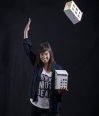
María Eloy-García (b. 1972, Málaga). Her work has been translated into German, English, Italian, Portuguese, Galician, Greek, Croatian, Macedonian, Hungarian, Serbian and Catalan.
- Diseños experimentales, Monosabio, Málaga, 1997.
- Metafísica del trapo, ed. Torremozas, Madrid, 2001.
- Cuánto dura cuánto, ed. El Gaviero, Almería 2007.
- Cuánto dura cuánto, 2ª edición, ed. El Gaviero, Almería 2010.
- Cuánto dura quanto, Lupo Editore, Lecce, Italia 2011.
- Los cantos de cada cual, ed. Arrebato, Madrid 2013.
- Los habitantes del panorama (prosas-poemas), ed. Arrebato, Madrid 2019.
- Cuánto dura cuánto, ed. Arrebato, Madrid 2024.


